
Building a successful online community for casual, personality-driven chat groups comes down to three things: a clear purpose, the right platform, and empowering the people who actually create energy in the room. Skip any one of those, and you get a ghost town with a nice logo.
The core elements you need from day one:
- A sharp identity stated in 12 words or fewer: who the community serves and what they share
- A matched platform chosen for the interaction style you want, not the one your team already uses
- A founding micro-group of 10–25 members who seed the culture before anyone else arrives
- Empowered creators who drive conversation while lurkers absorb value quietly
- Recurring engagement formats that give members a predictable reason to return
- Clear moderation guidelines with an enforcement ladder, set up before you need them
- A maintenance cycle of review, refine, welcome, engage, and reset to prevent stagnation
How to build an online community through its natural growth phases
Every community moves through three stages, and the biggest mistake builders make is treating a day-one group like a mature one.
Stage 1 (0–25 members): The Spark. The job here is proving there's a reason to gather. Personally welcome every member, ask what brought them, and connect at least two people to each other daily. You're not running events yet. You're building identity and trust.
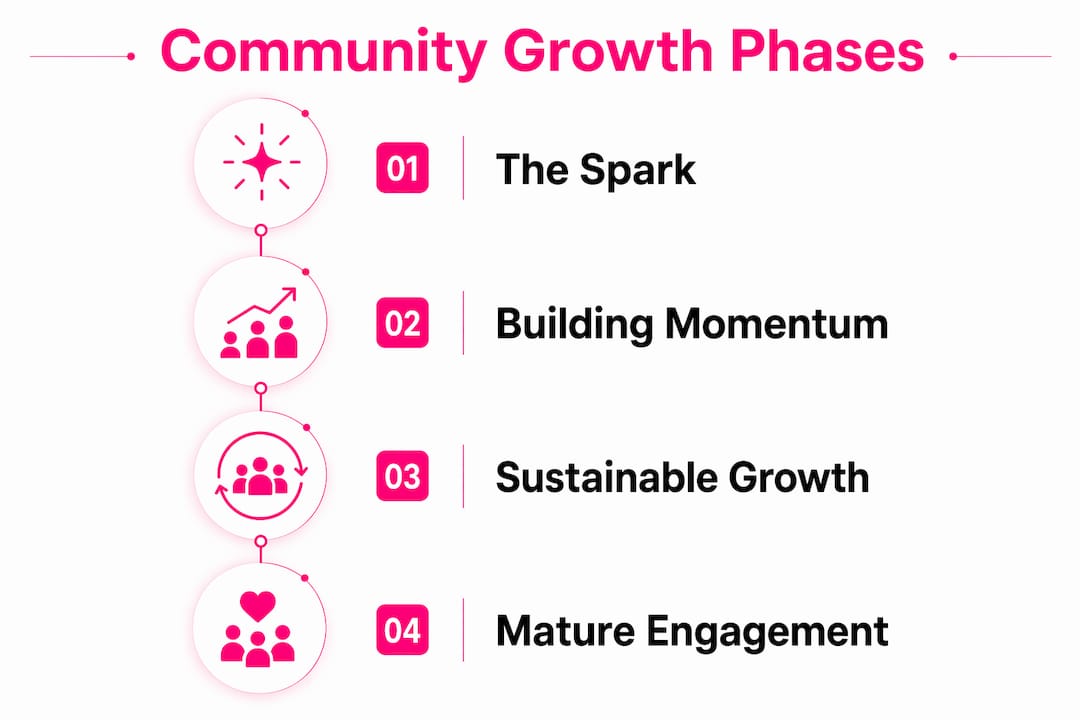
Stage 2 (25–250 members): Steady growth. A clear weekly rhythm emerges. Three to five power users reliably engage and welcome newcomers. Visible artifacts of past activity, popular threads, member shoutouts, and shared references, make the community feel real to anyone who arrives late.
Stage 3 (250+ members): Self-sustaining. Culture persists without the founder in every thread. Power users lead. Your job shifts to maintaining quality and stepping back. Getting here realistically takes 6–12 months, with the first 90 days setting the foundation and momentum compounding after that.
- Retention is most fragile in the first 30 days; onboarding is the critical lever during that window
- Rushing to scale before culture forms is the most common reason communities collapse
- A 90-day launch plan covering setup, spark, steady, and self-sustaining phases gives you a workable structure
Defining your purpose and choosing the right platform
The distinction between an audience and a community is not semantic. An audience is a one-to-many broadcast; a community is many-to-many, where value comes from members talking to each other, not just consuming from you. That difference shapes every platform decision you make.

Write your community's identity in 12 words or fewer: who it's for and what they're working toward together. If you can't do it in 12 words, your members won't be able to explain it to a friend either.
Platform choice follows interaction style:
-
Discord works for real-time, high-velocity chat and younger demographics, but requires heavy moderation because it moves fast
-
Skool and Circle suit asynchronous, forum-style interaction where knowledge gets archived and "chat fatigue" stays low
-
Personality-driven casual chat groups often fit real-time platforms best, provided moderation keeps up with the pace
-
Avoid platform mismatches: a community built for deep async discussion will feel dead on a real-time chat tool, and vice versa
-
Choose the platform that supports the member behavior you want to repeat, not the one that's easiest to set up
How participation dynamics actually work in casual chat groups
The 1-9-90 rule describes what happens in every online group: 1% of members create content, 9% contribute by replying or voting, and 90% lurk. This is not failure. It's normal human behavior.
The mistake is trying to force the 90% to post. Your actual job is to empower the 1% so they keep creating value for everyone else. Give power users visible roles, moderator privileges, or early access. Make their contributions publicly recognized.
- Lurkers absorb value and often convert to contributors when the barrier to entry drops
- Assign roles like "greeter," "veteran," or "moderator" to your top creators early, around days 31–60
- Avoid burnout by designing systems where creators get recognition without carrying the whole community alone
- Personality-driven groups thrive when member types are matched intentionally: new users need clear next steps, experienced members need high-signal discussion
Sustaining engagement, handling conflict, and keeping things alive
Recurring engagement rituals build habits more reliably than variety or high volume. One format run consistently for months beats five formats abandoned in three weeks.
Three formats that reliably work:
- Weekly wins thread: Members post their biggest win. High engagement, positive tone, easy for newcomers to join
- Themed discussion day: A named prompt on the same day each week lowers the barrier to posting and creates shorthand
- Office hours or AMA: Concentrates expertise into a predictable window instead of scattering support across the week
Moderation needs structure before chaos arrives. Effective moderation with an enforcement ladder prevents culture dilution as the group grows. One toxic member can drive away your top creators. Set up clear guidelines in plain language, with examples of what good participation looks like, and enforce them consistently.
- Onboarding shapes retention: a pinned welcome post, a narrow intro prompt, and one easy first action answer the three questions every new member has
- Use automation for routing and reminders, but keep human moderators visible for greetings and first-post replies
- A maintenance cycle of review, refine, welcome, engage, and reset prevents stagnation without requiring constant reinvention
Pro Tip: If your community goes quiet, the problem is almost never a content gap. DM your most recent joiners and ask what they were hoping for. The answer usually points to an onboarding or relevance issue, not a posting schedule.
How Talkingstage applies these principles in practice
Talkingstage is a social discovery platform built around exactly the kind of temporary, personality-driven community model this guide describes. Instead of open-ended social feeds, it matches people based on shared hobbies and interests, then drops them into temporary group chats where the connection either sparks or doesn't.
The platform's smart matching algorithm handles the founding micro-group problem automatically: members arrive already sharing a common interest, which seeds authentic conversation from the first message. Anonymous chatting lowers the social risk of a first post, and group voting to extend or end chats gives the community itself control over whether a group continues. That's the 1-9-90 rule built into the product design.
Talkingstage's dark, magenta-accented aesthetic isn't just visual branding. It signals the kind of energy the platform attracts: forward-thinking users who want dynamic, low-pressure digital connection rather than another follower count to manage.
Measuring community health beyond raw member counts
Treat your community like a product, not a campaign. Vanity metrics like total signups tell you almost nothing about whether the community is actually working.
The numbers that matter:
| Metric | What it tells you |
|---|---|
| Monthly active members | Whether people return after joining |
| Contributor rate | How many members post, not just read |
| Response latency | How quickly questions get answered |
| 30-day retention | Whether onboarding is working |
| Cohort retention | Where members drop off over time |
Early churn points to an onboarding gap. Mid-term churn points to an engagement gap. Both are fixable once you know which one you're dealing with. Track three numbers consistently: active members, who's posting, and how many stay month over month.
Scaling your community without losing what made it work
Culture dilutes naturally as membership grows. The fix is structural, not motivational.
- Enforce moderation before you feel like you need to. A single bad actor costs you your top creators.
- Separate conversation from support. Distinct paths for peer discussion, product questions, and account issues prevent the busiest channel from becoming a chaos dump.
- Add structure gradually. New channels, roles, and formats should follow demonstrated member need, not anticipated growth.
- Let power users lead more. As you scale, step back from individual threads and let your 1% carry the culture forward.
Launching broadly too early is one of the most common scaling mistakes. An empty or inconsistent experience before norms form kills momentum before it starts. Soft-launch with a trusted cohort, fix friction points, then open the doors.
Encouraging user-generated content and peer support
The best community content doesn't come from the founder. It comes from members who feel safe enough to share and recognized enough to keep doing it.
Formats that generate peer content reliably:
- Member spotlights: Feature a member's story or win publicly. It models the behavior you want and rewards the person doing it.
- "Roast my X" threads: In interest-based groups, constructive critique threads generate high engagement and genuine peer value.
- Anonymous prompts: Lower the social risk for members who want to contribute but aren't ready to attach their name to a post.
- Rotating member questions: Give different members the chance to pose the weekly question. It distributes ownership and surfaces new perspectives.
Peer support deepens when members feel seen by other members, not just by the community manager. Design formats that create member-to-member contact, not just member-to-host contact. That's the difference between an audience and a community that actually sustains itself.
Key Takeaways
Building a self-sustaining personality-driven online community requires a sharp purpose, empowered creators, and consistent engagement rituals maintained through a repeating review cycle.
| Point | Details |
|---|---|
| Start with 10–20 members | A small founding group seeds culture before scaling; rushing growth before norms form kills momentum. |
| Apply the 1-9-90 rule | Empower the 1% of creators with roles and recognition; don't pressure the 90% of lurkers to post. |
| Onboarding drives 30-day retention | Clear first steps, a narrow intro prompt, and one easy action keep new members from drifting. |
| Recurring formats beat variety | One consistent weekly thread run for months outperforms five formats abandoned quickly. |
| Measure activity quality, not signups | Track active members, contributor rate, and cohort retention to find and fix real engagement gaps. |