
Making friends in a new city takes intentional action, not luck. The most effective approach is to show up consistently in the same places, initiate specific plans, and give it more time than you expect. Here is what actually works.
- Say yes to almost everything early on. Early on, try to say yes to most social invitations to build momentum. Coworker happy hour, neighbor's housewarming, the yoga class your sister's friend mentioned — all of it counts.
- Make invitations concrete. "We should hang out sometime" rarely leads anywhere. "Want to grab coffee Saturday morning?" almost always does.
- Pick three places to become a regular. A coffee shop, a gym, and one spot that fits your lifestyle. Familiarity builds faster than you think.
- Alert your existing network. Tell friends, family, and former coworkers you moved. You would be surprised how many connections to your new city already exist in your network.
- Try Talkingstage. The platform matches you with people based on shared interests and personality, then drops you into temporary group chats where you can decide whether to keep the conversation going. It is a lower-pressure way to find people who actually share your passions before committing to an in-person meetup.
Why making friends in a new city feels so hard
Moving to a new city strips away the social scaffolding you built over years without replacing it overnight. No standing weekend plans, no friend-of-a-friend introductions, no coworkers you already trust. That absence is heavier than most people expect, and it is worth naming directly.
"Community is a lifeline; it's a human need to feel and be connected with the world around us. Making new friends after moving somewhere, especially as an adult, is justifiably daunting. It can be emotionally exhausting, and takes a real effort, so let's give ourselves some compassion." — Lewis Elliot, certified life coach, via Oprah Daily
Psychotherapist Samantha Kane echoes this: the process may feel like work at times, and that is completely normal. The goal is not to pretend it is easy. It is to keep going anyway.
Loneliness during the adjustment period is not a sign you made the wrong call. It is a sign you are in the middle of something genuinely hard. Recognizing that distinction matters because it keeps you from catastrophizing a slow week into a permanent verdict about your social life. Self-compassion during this transition is not a soft suggestion from therapists. It is a practical tool for avoiding the burnout that makes people give up before the connections have time to form.
One thing that catches people off guard: the awkwardness does not go away after the first few outings. It tends to linger for weeks. Embracing that discomfort, rather than treating it as a red flag, is what separates people who build a social circle from those who retreat indoors and wait for something to happen.
Proactive strategies that actually build friendships
The gap between meeting people and having real friends comes down to one thing: follow-up. Most potential friendships die because no one made the next step concrete. Here is how to close that gap.
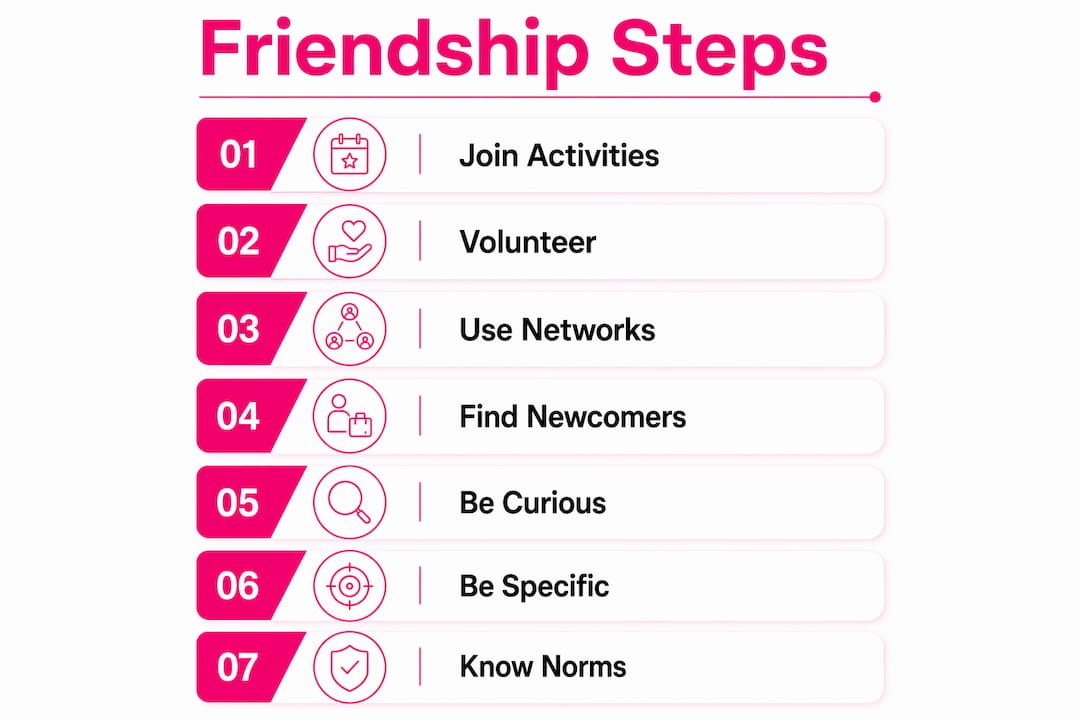
1. Join recurring activities, not one-off events
A single networking night gives you business cards. A weekly climbing class gives you the same faces every Thursday. Repeated exposure is the psychological engine behind friendship formation. Friendship coach Danielle Bayard Jackson puts it plainly: go to an event three times before you make up your mind, because by the third visit you can say, "How is your dog doing?" instead of starting from zero again.

2. Volunteer for something you actually care about
Volunteering puts you alongside people who share your values, gives you an immediate sense of purpose in a new place, and creates a built-in reason to keep showing up. Those three things together are exactly what friendship requires.
3. Use your workplace and professional networks
Even casual lunch invitations can become real friendships over time. Work-sponsored events are particularly useful because everyone already has a common connection and the social stakes are lower. If you work remotely, a coworking space serves the same function.

4. Look for other newcomers specifically
Transitioners, people who are also new to an environment, are especially open to spending time with new friends. Their schedules tend to be more open and they understand the situation without you having to explain it. When you meet someone else who just moved, follow up with them first.
5. Lead with curiosity, not performance
Anxiety pushes people to perform "interesting person" instead of becoming genuinely interested in the person in front of them. Active listening and thoughtful follow-up questions build more rapport than any rehearsed story about yourself. Ask something that invites a real answer, then actually listen to it.
6. Lean into what makes you specific
Friendship coach Bayard Jackson's counterintuitive advice: you will find your people faster if you lead with the quirky or niche things about yourself rather than playing it safe. The things you think might be too weird are often exactly what attract the right people.
7. Understand local social norms
Every city has its own rhythm. Some places are warm to strangers immediately; others take longer to open up. Paying attention to how locals interact, where they gather, and what they talk about helps you meet people on their terms rather than yours.
Pro Tip: When you invite someone to hang out, include a duration. Saying "coffee for about an hour" lets people know how long to charge their social battery for, which makes them far more likely to say yes.
How to use social apps without wasting months on them
Social apps are a starting point, not a destination. The mistake most people make is treating them as passive waiting rooms, checking notifications and hoping connection just happens. Apps work best as tools to get you to a first meeting, not as substitutes for the in-person contact that actually builds friendship.
- Be proactive after matching. Send the message. Suggest the specific plan. Do not wait for the other person to do it.
- Move offline quickly. The goal of any app-based connection is a real-world meetup. The longer you stay in the chat, the more the connection fades.
- Set realistic expectations. An app can introduce you to someone worth knowing. It cannot compress the months of repeated contact that friendship actually requires.
- Combine online and offline. Use apps to find people, then use recurring local activities to build the relationship.
Talkingstage takes a different approach than most social platforms. Instead of one-on-one cold messaging, it drops you into temporary group chats with people who share your specific interests and personality profile. You get to see how someone actually engages in a group conversation before deciding whether to take it further. That context makes the eventual in-person meetup feel far less like a gamble.
Meetup is worth using for finding recurring interest-based events in most mid-to-large cities. Facebook Groups for transplant communities ("New to Austin," "Chicago Newcomers") are often more active than people realize. These tools work when you treat them as a first step, not the whole plan.
How long does it actually take to build a social circle?
Longer than you want it to. Most people start feeling settled after several months, but building real, close friendships takes sustained effort over a longer period—often a year or more. Adult friendships generally form more slowly than those made in school. That is not a flaw in the process. It is just how adult social life works.
The hardest part is the lag between effort and belonging. You can do everything right, show up consistently, follow up, initiate plans, and still feel like nothing is clicking for weeks. That lag is normal. Friendship-building is a gradual process requiring repeated engagement over time, not a quick transformation.
A few things that help during the slow stretch:
The mere exposure effect is real. The more you see the same person, the more you tend to like them. This is why routine attendance at the same activity beats attending a dozen different one-off events. You are not just meeting people. You are accumulating the repeated contact that makes liking someone feel natural.
Build multiple kinds of connections rather than putting all your social weight on one or two people. Not everyone has to become a close friend. Casual ties with a neighbor, a barista who knows your order, and a gym regular you chat with on Tuesdays all contribute to a sense of belonging. When one person is busy, you are not suddenly alone.
Friendliness is not friendship. A warm conversation at a party is the starting material, but it needs follow-up and mutual effort before it becomes something you can count on. Enjoy the pleasant interaction without deciding it is either your new best friend or proof that you will never connect with anyone here.
Talkingstage makes the first step easier
Finding people who genuinely share your interests is the hardest part of building a social life in a new city. Most apps put you in front of strangers with no shared context and leave you to figure out the rest.

Talkingstage works differently. You select your interests and hobbies, and the platform's matching algorithm connects you with people who share them, then places you in temporary group chats where the conversation starts naturally around something you all actually care about. There is no cold-message anxiety, no awkward "so what do you do" opener. You can see how people engage before deciding whether to keep the connection going or swap contact details.
For anyone who just moved and wants to meet like-minded people without the pressure of one-on-one cold outreach, Talkingstage is a genuinely different starting point. Join Talkingstage and find your first group chat today.
Key Takeaways
Building a social circle in a new city takes consistent effort over months, not days, and the people who succeed are the ones who keep showing up even when progress feels invisible.
| Point | Details |
|---|---|
| Start immediately | Say yes to almost everything early on to build social momentum before selective habits set in. |
| Consistency beats variety | Repeated exposure to the same people, through recurring activities, is what turns acquaintances into friends. |
| Follow up with specifics | Vague plans die; concrete invitations with a time, place, and duration almost always lead somewhere. |
| Expect a long timeline | Real, close friendships can take a year or more to develop in adulthood. Patience is not optional. |
| Talkingstage for new connections | Interest-based group chats on Talkingstage reduce cold-outreach anxiety and surface people who share your passions. |