
Making friends online works best when you stop treating it like networking and start treating it like showing up. The platforms that actually produce real friendships share three traits: they're built around shared interests rather than follower counts, they reduce the pressure to perform, and they make it easy to show up repeatedly. Here's what that looks like in practice:
- Start on platforms designed for platonic connection, not dating or professional networking.
- Engage consistently over time. Repeated contact matters more than any single deep conversation.
- Move to voice when you can. Tone and laughter carry things text simply cannot.
- Choose communities built around something you genuinely care about.
- Be the one to reach out first. Most people want to connect but wait for someone else to go first.
- Lower the bar for what counts as a real friendship. Consistency beats intensity.
- Be honest and reciprocal. Friendships that last require both people to show up.
Table of Contents
- Where to make friends online: the best platforms right now
- How to build and maintain online friendships that actually last
- What research actually says about online friendships
- Which platforms are genuinely worth your time
- What makes a friend-making platform actually work
- The different kinds of online friendships you might build
- Staying safe when you meet new people online
- Talkingstage connects you with people who actually share your world
- Key Takeaways
Where to make friends online: the best platforms right now
The platforms worth your time fall into a few distinct categories: social discovery apps built specifically for platonic matching, interest-based communities where friendship is a byproduct of shared passion, and anonymous or low-stakes chat environments that let you drop the performance pressure.
| Platform | Anonymity | Voice/Video | Group Chats | Matching Algorithm | Best For |
|---|---|---|---|---|---|
| Talkingstage | Yes (optional) | Yes | Yes (temporary) | Personality + interest | Platonic discovery, low-pressure intros |
| FriendMatch | No | No | No | Profile-based | Adults seeking pen pals and local friends |
| Reddit communities | Yes | No | Yes | Interest-based | Niche hobby groups |
| Discord servers | Partial | Yes | Yes | Topic-based | Gaming, fandoms, creative communities |
| Meetup (online events) | No | Yes | Yes | Location + interest | Local-to-online crossover |
Talkingstage uses personality-based matching combined with interest and hobby selection, then drops you into a temporary group chat with people who share your passions. The group votes on whether to keep the conversation going or end it, which removes the awkward one-on-one cold-start problem entirely. Personality and interest matching like this consistently produces more genuine initial connections than profile-browsing alone.
FriendMatch takes a slower, more deliberate approach. It's built entirely around platonic friendship, with profiles that emphasize personality and interests over photos. There's no swiping, no algorithm-driven feed. You browse, you reach out, you see what happens. It suits people who want something closer to a pen pal relationship before committing to real-time conversation.
Reddit and Discord aren't friendship apps, but they're where a lot of real online friendships actually start. The key is picking a community small enough that you become a recognizable presence over time. A subreddit with 50,000 members is too large. A Discord server for a specific game or creative project, where the same 30 people show up every week, is where familiarity builds.
How to build and maintain online friendships that actually last
The single biggest mistake people make when trying to connect online is treating it like a one-time event. You send a message, you have a great conversation, and then you wait. Nothing happens. The friendship dies before it starts.
- Lead with genuine curiosity. Ask about something specific from their profile or a post they made, not a generic "hey, how are you?"
- Show up consistently on the same platform. Digital propinquity works the same way physical proximity does: repeated presence turns strangers into familiar faces.
- Use voice when possible. A 20-minute voice call does more for a friendship than two weeks of text messages.
- Share something real about yourself. Reciprocal vulnerability is what separates acquaintances from actual friends.
- Initiate follow-ups. Don't wait. Most adults misjudge how receptive others will be to being reached out to.
- Create shared experiences. Watch the same show, play the same game, read the same book. Shared context is friendship glue.
- Redefine what friendship means to you. A person you check in with every week about a shared interest is a real friend, even if you've never met in person.
Pro Tip: If you feel performance pressure in one-on-one chats, start on platforms that use anonymous or group formats. When the stakes feel lower, you drop the curated version of yourself and actually connect.
What research actually says about online friendships
Adult friendship formation is structurally harder than most people realize. Unlike childhood, where school and proximity do the work automatically, adult friendships require deliberate engineering. Research by Jeffrey Hall at the University of Kansas found it takes 50 hours to reach casual friendship and around 200 hours to develop a close one. That's not a discouraging number. It's a clarifying one: the goal isn't a single great conversation, it's accumulated time.
"Online-only friendships can develop deep, complex emotional bonds that rival face-to-face relationships, especially when shared interests and consistent communication exist." — ACM CSCW research on online friendship experiences
The stigma around online friendships is largely a cultural artifact. Digital sociology research finds that the idea of online friendships being inherently inferior is culturally constructed and ignores the reality that online-only friends often provide support structures that offline relationships simply can't. Someone in a small town with no local community for their interests isn't settling for an online friend. They're finding the only community that actually fits.
Social media complicates this. Kristina Lerman's 2025 essay "Strong Friendship Paradox in Social Networks" documented how platforms like Instagram create the illusion that others have richer friendships than you do. That perception drives shame and passivity, which are the two things most likely to kill a friendship before it starts. The fix isn't to scroll less. It's to move from passive browsing to active participation in smaller, interest-specific communities.
Values similarity plays a measurable role in online friendship formation. Research across two studies found robust associations between value congruence and friendship interest when meeting someone online for the first time, particularly for openness and conservation values. Platforms that surface shared interests and personality traits early in the discovery process aren't just convenient. They're doing real friendship science.
Which platforms are genuinely worth your time
The best platforms for making friends online share a few non-negotiable qualities: they're built for platonic connection, they make shared interests visible early, and they give you a reason to come back repeatedly.
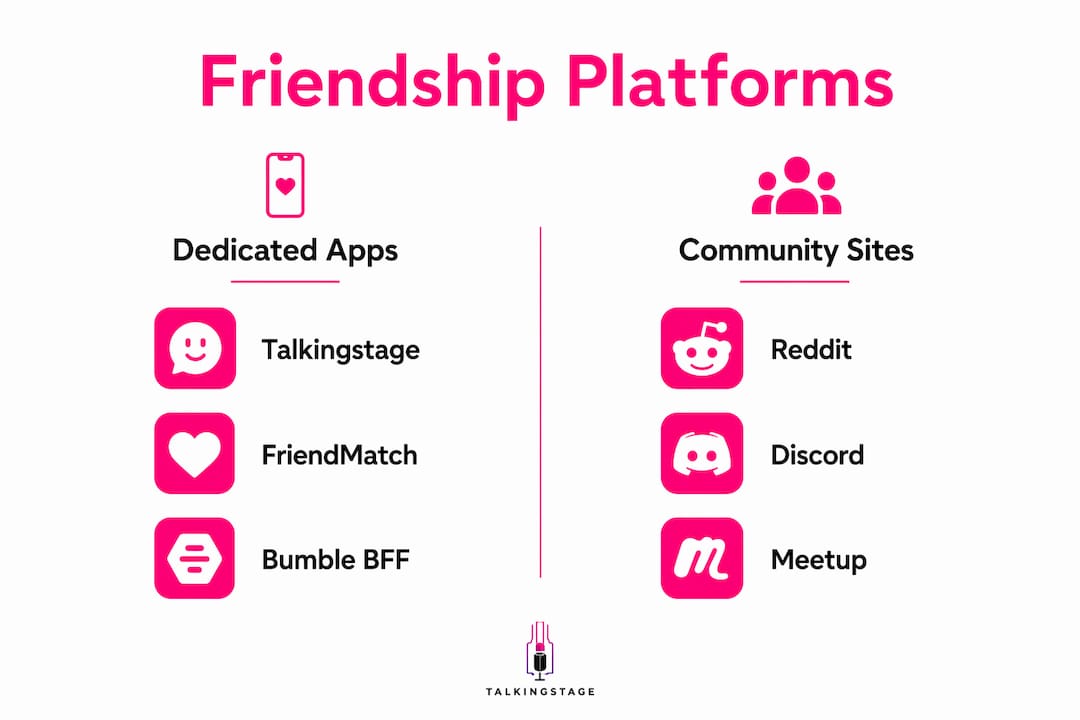
Talkingstage stands out because it addresses the hardest part of online friendship: the cold start. Temporary group chats with personality-matched strangers mean you're never stuck in a one-on-one conversation with someone you know nothing about. The group format lowers stakes, the matching surfaces compatibility, and the vote-to-continue mechanic means everyone in the chat actually wants to be there.
FriendMatch is one of the few platforms built exclusively for platonic friendship. No romantic matching, no follower dynamics. It's slower and more deliberate, which suits people who find fast-paced social apps exhausting.
Interest-based communities on Reddit and Discord remain underrated for friendship. The catch is commitment: you have to show up enough times that people recognize your username. That's the propinquity effect at work, and it's more powerful than any single conversation for turning strangers into friends.
What makes a friend-making platform actually work
Not all social platforms are built the same, and the features that matter for friendship are different from the ones that matter for dating or networking.
Anonymity options reduce impression management. When you're not worried about being judged on your photo or your follower count, you're more likely to say something real.

Voice and video support accelerates emotional connection. Text is efficient but flat. Voice restores tone, laughter, and the natural rhythm of conversation.
Group chat formats solve the cold-start problem. One-on-one conversations with strangers are high-pressure. Group formats distribute that pressure and let personality emerge more naturally.

Matching algorithms based on personality and interests do the filtering work upfront. Displaying things in common between users significantly increases friendship formation, especially among people who wouldn't have found each other otherwise.
Repeat-visit incentives matter more than most people think. A platform that gives you a reason to come back weekly builds the accumulated contact time that friendship actually requires.
The different kinds of online friendships you might build
Not every online friendship needs to become a lifelong bond, and expecting that sets you up for disappointment.
Casual interest-based friendships are the most common. You share a hobby, a fandom, or a creative project. You talk when there's something to talk about. These are real friendships, even if they're bounded by context.
Close online friendships develop when two people invest consistently over time, share personal experiences, and move beyond the original shared interest. These often involve voice or video calls and feel indistinguishable from offline close friendships in terms of emotional depth.
Community friendships are the social fabric of a Discord server or subreddit. You're not close with any one person, but you feel a genuine sense of belonging. These matter for mental health even when they don't produce individual close friends.
Cross-platform friendships start in one place and migrate to others as trust builds. Someone you met in a group chat moves to direct messages, then to voice calls, then maybe to a video call. Each step deepens the connection.
Staying safe when you meet new people online
Safety online isn't about paranoia. It's about smart defaults that protect you without preventing real connection.
- Keep personal details like your full name, address, and workplace off your profile until you've established real trust.
- Use platform messaging before moving to personal phone numbers or social media accounts.
- Trust your instincts. If someone pushes for personal information quickly or the conversation feels off, it's fine to disengage.
- Reverse image search profile photos if something feels inconsistent. Fake profiles often use stock images or photos pulled from other accounts.
- Prefer platforms with reporting and blocking tools that are easy to use.
- If you move to video calls, use a neutral background and avoid showing identifiable details of your home.
Real friendships don't require you to hand over your privacy upfront. Anyone who pressures you to do so before trust is established is a red flag, not a fast-track to connection.
Talkingstage connects you with people who actually share your world
Most social apps put you in front of strangers and leave you to figure out the rest. Talkingstage is built differently. It matches you based on personality, hobbies, and genuine interests, then places you in a temporary group chat where the conversation starts naturally and the group decides together whether to keep it going.

There's no pressure to perform for an audience, no follower count to manage, and no awkward one-on-one cold start. The anonymous chat option means you can show up as yourself before deciding whether to share more. For adults who want platonic connection without the noise of mainstream social media, Talkingstage offers a format that actually fits how friendships form: through shared interests, low-stakes conversation, and the freedom to take it at your own pace. Start matching on Talkingstage and find people who are genuinely there for the same reason you are.
Key Takeaways
The most effective way to make friends online combines consistent presence, shared interests, and platforms that reduce performance pressure from the start.
| Point | Details |
|---|---|
| Consistency beats intensity | Research shows casual friendship takes around 50 hours of contact; showing up repeatedly matters more than one great conversation. |
| Voice accelerates connection | Moving from text to voice restores tone and laughter, deepening emotional bonds faster than text alone. |
| Platform design matters | Features like anonymity, group chats, and interest-based matching directly affect whether genuine friendships form. |
| Online friendships are real | Digital sociology research confirms online-only friendships can match offline ones in emotional depth and support quality. |
| Talkingstage | Uses personality and interest matching with temporary group chats to create low-pressure, genuine platonic connections. |